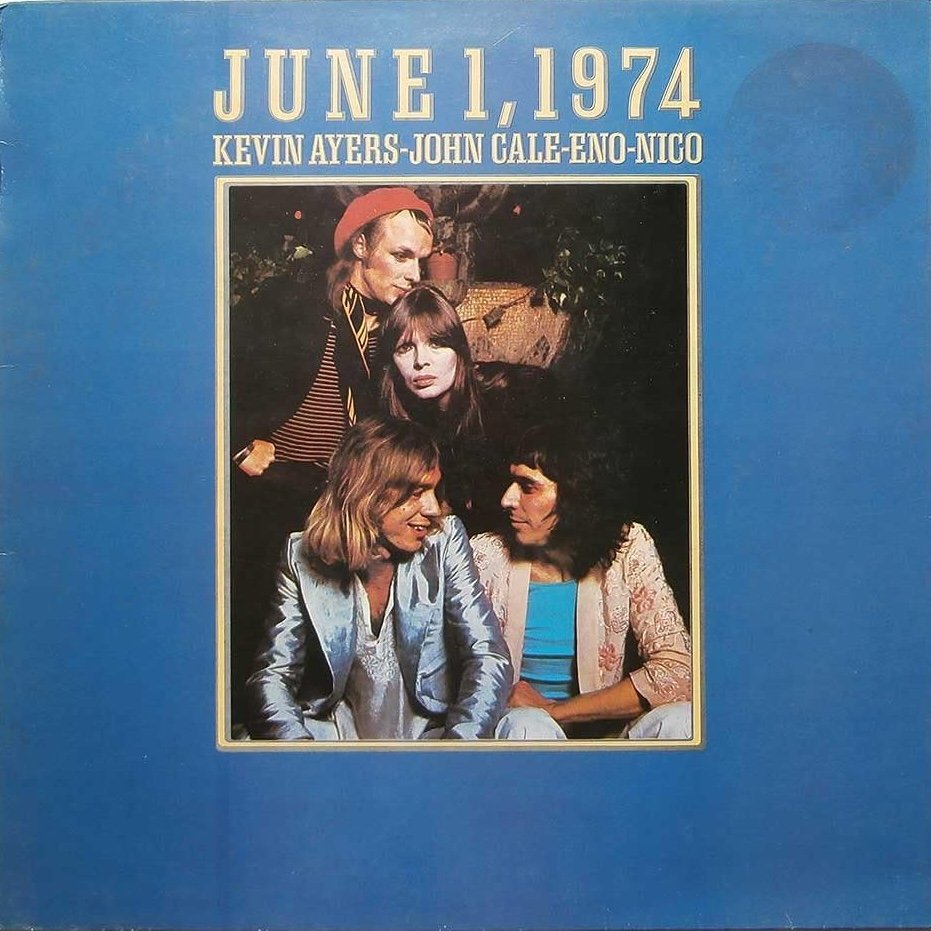
Issues weren’t having a look up in 1974. From oil-crisis-induced austerity to Watergate in america, the West was once present process a pan-cultural frightened breakdown. Dangerous vibes abounded at each and every flip; the hippie dream deferred, as transparent within the headlines as in Hollywood. However no cultural record captures that generation’s transitional unease higher than June 1, 1974, an artwork rock meeting-of-the-minds that positioned luminaries Kevin Ayers, John Cale, Nico and Brian Eno ahead of a bewildered reside target audience at London’s Rainbow Theatre. Launched fifty years in the past this month, its efficiency – and oddness – stays intact.
Its mythology additionally looms massive. Even lately, the listing’s calling card quantities in large part to the affair going on between Ayers and Cale’s then-wife, Cindy Wells, the evening ahead of the efficiency. The salaciousness of that stumble upon – and its ensuing whiff of scandal – has restricted the listing’s legacy within the many years since, an unlucky distraction irrespective of its myth-making energy. (Wells had already been sort-of memorialised in Eno’s ‘Cindy Tells Me’ the former yr; Ayers would obtain much less beneficial remedy following the affair, described as “the bugger within the quick sleeves” in Cale’s ‘Guts’, an album observe on 1975’s Sluggish Dazzle.)
The strain is obvious in Mick Rock’s delightfully decadent duvet picture. Straight away, we’re head to head with our topics in more than a few technicolor sunglasses of satin – or, for Nico, jet black – and Eno’s cherry-red beret. Cale and Ayers are seated within the foreground, observing at every different with sheepish amusement (Ayers) and confrontational depth (Cale).
Now not pictured are the evening’s slew of backup avid gamers, maximum notable amongst them Mike Oldfield, Phil Manzanera, and Robert Wyatt. (Eerily, this live performance additionally marked the one-year anniversary of Wyatt’s fall from poet “Woman” June Campbell Cramer’s fourth-story window in Maida Vale, rendering him paralysed from the waist down. Two receive advantages live shows organised through Purple Floyd – and introduced through a tender John Peel – had been held on the Rainbow the former November.)
Within the previous weeks, an keen track press fanned whispers of a Velvet Underground reunion – with Eno changing Lou Reed. (In spite of everything, Reed, Cale and Nico had spontaneously reconvened at Parisian venue the Bataclan in 1972; possibly it might occur once more?) However as Eno would recall to Creem’s Richard Cromelin: “I didn’t need to move on level to be judged as Lou Reed’s alternative. Other people would come alongside and be expecting me to sing ‘Heroin.’”
If truth be told, the excitement of a rumoured Velvets/Cushy Device super-summit obscured how a lot cross-pollination had already befell between the 4 concerned. On the time of the display, Eno was once busy helping with Cale’s Island Information debut, Concern, which itself “gave delivery to the potential of the June 1 live performance,” as Eno would inform Hit Parader in 1975. 4 years previous, Cale produced Nico’s plaintive Desertshore, a listing whose identify Ayers name-checked in his personal ode to Nico, ‘Decadence’, on 1972’s Bananamour. Indisputably, Eno’s later-conceived thought of “scenius” was once neatly underway. However for the post-hippie track scene, the entice of one thing “tremendous” was once sturdy, and any communicate of a supergroup would most likely face a bull marketplace.
The foursome – not-so-lovingly named “ACNE” within the Gasbag phase of NME – had till then occupied handiest the extra far-flung corners of rock’s leading edge magnificence. Accordingly, few would have pegged any of the quartet ripe for supergroup billing. (If anything else, Oldfied, contemporary off the Exorcist-indebted good fortune of 1973’s Tubular Bells, had the closest declare. The 18 Might duvet of Melody Maker featured a splashy preview of the gig, touting, so as: “Oldfield, Eno, Nico – Are living!”)
However, Richard Williams, the newly minted Island A&R and previous Melody Maker editor himself, was once keen to attract consideration to the label’s extra outré fresh signings. As he lately recounted to Uncut, the speculation was once hatched “over a lunch for 5 at an Italian eating place known as Gatamelata on Kensington Top Side road” on 13 Might – lower than 3 weeks ahead of the live performance. With a realizing nod to the extra ear-to-the-ground crowds Williams and his label had been unquestionably relationship, the accompanying LP could be meant “as one of those legitimate bootleg.”
A much more likely rationale, says David Sheppard within the Eno biography On Some Far flung Seashore, was once Williams’ try to gin-up hype. He were looking for a strategy to recoup the squandered advances to Ayers’ follow-up to The Confessions Of Dr. Dream And Different Tales, launched on Island previous that yr. The live performance and resulting reside album, Sheppard writes, thus served the twin goal of taking pictures a brand new set of Ayers subject matter whilst lending Eno, Nico, and Cale – all fresh Island signees – some “much-needed oxygen of exposure.”
The live performance offered out temporarily however the ensuing album loved a cooler reception. Recorded through John Wooden by means of the label’s cellular studio, handiest choose highlights from the night time could be selected for the ensuing LP: a sampling of every of the 4 avid gamers, with Ayers encompassing the whole lot of the second one facet. It was once rush-released on the finish of the month and did not chart.
Audiences, it appeared, had been nonetheless at the hunt for brand new heroes. In spite of a more youthful UK track press “now in large part staffed through writers who knew concerning the Velvets and the Cushy Device,” as Williams recalled, the quest endured.
The mainstream rock panorama introduced few clues. Prog was once temporarily spiraling into self-parody; the Stones had been exchanging tax exile for mid-tempo assurances that their schtick was once now “handiest rock‘n’roll,” so totally covering their authentic threat that it’s good to now take them at their phrase; even Bowie and Bolan appeared conscious that glam’s time was once up.
Roxy Song’s debut introduced a much-needed corrective to the ossifying myths of rock’s late-60s heyday. However in spite of their advice of the marketplace attainable for that heyday’s artier, lesser-known lines, a bigger sea trade was once inevitable. And although punk’s stripped down brutality wouldn’t totally crystalise till past due the next yr, its sense of chaos and disagreement had been very a lot on show at its 1 June vernissage.
Eno started the evening. The set’s nightmarish tone is obvious from the highest, with Eno turning in deliriously ecstatic and mechanistic variations of Heat Jets highlights ‘Using Me Backwards’ and ‘Child’s On Hearth’, the latter that includes a Roxy-plundered Manzanera on guitar.
Subsequent had been Cale and Nico, who had been extra involved in exhuming the graves of new rock & roll previous. Cale’s caterwauling tackle ‘Heartbreak Lodge’ reaches heights (or depths) a long way exceeding Elvis’s authentic; and Nico’s saturnine model of The Doorways’ Oedipal odyssey ‘The Finish’ labored as a double-eulogy to her soulmate-in-absentia, Jim Morrison, and the doomed generation he embodied. Each tracks would transform central fixtures of their respective catalogues, every artist making use of their singular lenses not to simply remake or rework however reimagine totally the probabilities of the rock shape. Their contributions are shockingly efficient, proving why rock was once in such determined want of an post-mortem extra thorough than, say, Bowie’s Pin Ups to totally smash with its dead-end previous.
Ayers’ set, against this, was once mellower and more uncomplicated, typifying his sublime wino-on-permanent-holiday mystique. Buffeted through characteristically louche renderings of the folky ‘Stranger In Blue Suede Footwear’ and the fairly creepy ‘Might I?’, Ayers was once joined handiest through backing singers and his band. (Eno, Nico, and Cale had been behind the curtain toasting celebratory champagne, rising just for the valedictory jam ‘Two Is going Into 4’ and a bookending reprisal of ‘Child’s On Hearth’, which was once no longer incorporated on-record.)
Frustratingly – however fittingly, in hindsight – lots of the evening’s extra fascinating moments had been left at the cutting-room ground, rising handiest on sought-after bootlegs. Completists would possibly mourn the lack of Ayers masterpiece ‘Whatevershebringswesing’, that includes a transferring solo through Oldfield; early previews of Cale’s Concern classics ‘Gun’ and ‘Buffalo Ballet’; and Nico first pushing target audience buttons with ‘Deutschland Uber Alles’. (She would galvanize a near-riot when she carried out it along Cale and Eno in West Berlin’s Neue Nationalgalerie later that summer season.)
Even the display’s introduction fable can have been juiced additional. One in every of Ayers’ ultimate songs was once the giddily lecherous ‘I’ve Were given A Exhausting-On For You Child’ – nonetheless but to be launched any place – that noticed Ayers joined through Cale at the titular chorus, the prior evening’s infidelities however. Such was once the power in their devotion to the development’s collaborative venture.
Eno understood that venture from the leap. As he stressed out to Hit Parader, supergroups to that time were a “crisis” as a result of they tended to convey out “the bottom commonplace denominator” of all concerned: “You don’t convey out the most efficient issues in them, you convey out the issues the place all of them agree, which is much down right here.” Towards that background, June 1 was once a good fortune, he mentioned, as it as an alternative pioneered “the speculation of the celebrity get-together.”
There’s one thing to this delicate shift in phraseology. Perhaps it belies a extra really extensive shift in stakes or expectancies: it most likely performed to ACNE’s merit that nobody provide, with the imaginable exception of Oldfield, would normally were regarded as a “celebrity”. However on the other hand, possibly this wasn’t a “get collectively” within the come-on-people-now sense such a lot because it was once a recasting of the unique Warholian “taking place” – and with it, Warhol’s Manufacturing unit imaginative and prescient of the “celebrity”. In all probability Eno and Williams had been reconjuring one of the Velvets’ art-world sensibility, adopting their pose exactly on the time their affect was once in spite of everything on the upward thrust.
Witness, too, how tidily June 1, 1974 suits inside of Eno’s better theories of procedure, randomness (“honour thy mistake as a hidden aim”), and closed techniques that may nearly instantly thereafter transform his stock-in-trade. Right here, we’re given an early rendering of Eno’s “scenius”-as-system, the place the folks themselves are the cogs in a bigger sound-making – or star-making – gadget.
Eno was once already reliably lending his VCS3-in-a-suitcase “therapies” to all means of tools within the studio. (Peter Gabriel dubbed it “Enossification” on 1974’s The Lamb Lies Down On Broadway; Wyatt would credit score a equivalent procedure to Eno’s “direct inject anti-jazz ray gun” on 1975’s Ruth Is Stranger Than Richard.)
From the beginning, Eno’s knack for designing inventive workarounds and compositional “issues” afforded him a undeniable ministerial luxurious: as soon as the entirety was once set just-so, he may just stand again and let the machines whirr at will. On June 1, 1974, the machines took place to be the 4 artists themselves – along side a couple of auxiliary avid gamers of equivalent renown – whose handiest limitation looked to be what apply time (or their more than a few appetites) would possibly permit.
Unsurprisingly, Eno followed a managerial function all the way through rehearsals, surroundings the tune order and choreographing level entrances and exits. He would later believe the venture under-prepared, the inevitable results of duelling egos and Cale’s more and more erratic behaviour and anxiousness over his reside debut. However, as Sheppard put it, Eno “relished the speculation of fusing musical like-minds into one, extremely targeted tournament.”
Such fusion could be short-lasting, as he defined to Hit Parader: “It was once an excessively risky state of affairs and the ones are those that pastime me in track. We weren’t sitting round patting every different at the again pronouncing ‘groovy,’ ‘let’s blow collectively’ – it was once fairly intense.” (The 2 follow-up ACNE outings in Birmingham and Manchester had been extra modest. When Williams booked the foursome for a unfastened competition in Hyde Park on the finish of the month, handiest Ayers and Nico confirmed up.)
After all, June 1, 1974 – its diary-date identify nearly tough to be recognised in a fuller ancient context – was once itself a mirrored image of the days. With all its misadventures (each behind the curtain and on), June 1, 1974 can also be observed as an Altamont for rock’s imperial segment: glam’s pomp giving strategy to the paranoia, decadence and experimentation of its artier fringes.
Its constituent units can be learn as a kind of Rosetta Stone charting rock’s disjointed trajectory during the decade. Inside of them, you’ll pay attention all of it: punk’s squall in ‘Heartbreak Lodge’; publish punk’s extra angular and textural fixations on ‘Child’s On Hearth’; even Ayers’ luude-friendly folks balladry and Nico’s desolate harmonium are worthy choice soundtracks to the last decade’s creeping malaise and alienation.
Fifty years on, the evening’s sense of foreboding feels much more prescient. Audiences nonetheless clutching to the remaining vestiges of ‘Loose Love’ had been fairly actually met with the cruel 70s truth of Cale’s mewling viola and Nico’s funereal drone. This was once the sound of “flower energy” marooned at the desertshore, the hippie lapse into solipsistic indulgence bottled as an acidic Rhône Valley pinot, the very second when all of glam’s sizzling stuff grew to become to flotsam. The nights in white satin had reached an finish, and punk’s ink-black morning time – and, quickly sufficient, Thatcher – had been rapid coming near.
That there’s proof of ACNE’s assembly in any respect, then, is a minor miracle. Regardless that the night time’s slapdash execution and patience-baiting sonic antics had been most likely as inevitable as its messy backstory, their asymmetric – however undeniably impressed – performances discuss to the freeing attainable of collaboration when the heavier star-marker equipment is solid apart.
In all probability June 1, 1974 continues to resonate exactly as a result of its ACNE namesakes declined to fulfill the oversized expectancies that have a tendency to accompany the “supergroup” tag. As a substitute, we’re given a competing imaginative and prescient of what a supergroup (or celebrity) may well be: Right here was once an anti-supergroup – one whose under-preparation, chance-worship, and anti-chemistry took precedent over non violent simple emotions and business compromise.
Just like the Beatles’ break-up (or Altamont itself), the “failure” of June 1, 1974 stays one in all its biggest belongings within the cultural reminiscence. Above all, it demonstrates how lightning-in-a-bottle moments of shared spontaneity occasionally require scary expectancies, somewhat of impermanence and ephemerality, and somewhat of mud for long run uncovering – like Ozymandias in opposite. To cite Christgau (who were given it proper this time): “If there’s gotta be art-rock, Lord, let or not it’s like this.”
So by no means thoughts the affair that lengthy since overshadowed the listing’s legacy – the triumph of June 1, 1974 lies in what it in truth succeeded in taking pictures: a placing and from time to time terrifying snapshot of a cracked-up counterculture in transition, unflinchingly rendered through 4 artists who exemplified that transition like no person else.
After all it was once by no means going to be repeated.