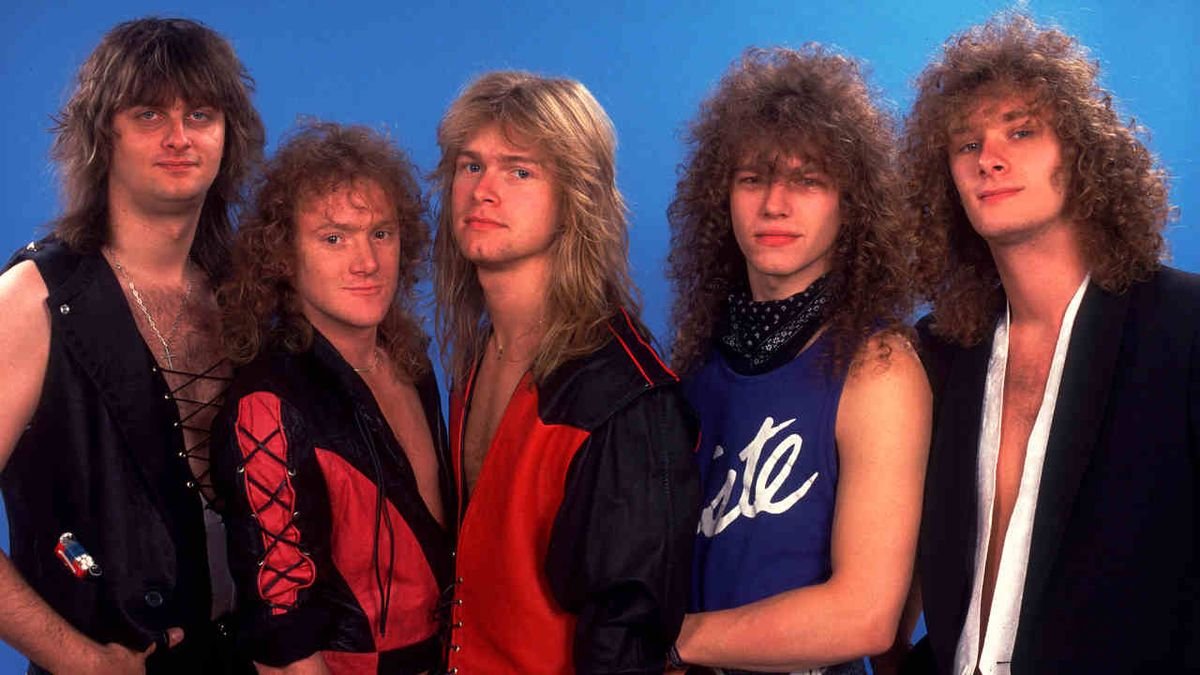
The 80s noticed steel splintering into a number of thrilling new subgenres: thrash, loss of life steel, commercial. And in Germany, a former thrash band referred to as Helloween drew up the blueprint for energy steel as we understand it with two albums that will in brief flip them into steel’s Subsequent Giant Issues: Keeper Of The Seven Keys: Section I and Section II.
“We knew we had get a hold of one thing particular,” says Kai Hansen, Helloween’s founding guitarist. “They have been data which we knew would make an affect – take us to the following degree.”
The roots of Helloween dated again to 1979, when Hansen and fellow guitarist Piet Sielck shaped a band referred to as Ironfist of their local Hamburg. The road-up used to be finished by means of Ingo Schwichtenberg on drums and Markus Grosskopf on bass. After Sielck left to change into a valid engineer, he changed by means of former Powerfool guitarist Michael Weikath.
By way of 1984, Ironfist had modified their identify to Helloween and bagged a place at the misleadingly-titled compilation Demise Steel, launched by means of soon-to-become influential German label Noise Data. The 2 tracks they contributed, Oernst For Existence and Steel Invaders, along with the next yr’s Helloween EP and Partitions Of Jericho album, established their sound – one thing Hansen describes as “Iron Maiden on velocity”.
Hansen had doubled up on vocal tasks to that time, however he used to be feeling overstretched. He knew Helloween wanted one thing additional. “The guitar portions have been getting increasingly more difficult, and I actually had to pay attention to that a part of what I did for the band,” he says. “Looking to carry out are living used to be getting difficult for me, so it used to be determined that we wanted to usher in any other singer.”
After an intensive seek, 18-year-old powerhouse vocalist Michael Kiske – previously of German band Unwell Prophecy– used to be drafted in, regardless that Hansen had his doubts to start with. “What he did appeared too cushy for Helloween,” the guitarist admits. “My vocals have been rougher. Extra heavy steel. And I simply didn’t see Michael becoming in. However slowly he gained me over. I got here to grasp what he may just give to this band.”

Kiske’s arrival cemented what would change into the vintage Helloween line-up. Hansen and Weikath, the band’s leader songwriters, had accumulated a hefty stash of songs. Invigorated, they cooked up a daring plan for the following album.
“We would have liked to do a double,” says Hansen. “Severely, we had the songs and the idea that in position. No fashionable steel band had ever accomplished a double studio report ahead of, and we desperately sought after to be the primary. However our label, Noise, have been totally towards it. We fought them actually onerous, and attempted to steer everybody what a perfect thought it used to be. However finally, we misplaced. Any such disgrace, as I felt the undertaking misplaced one thing.”
As an alternative, the band and the label elected to unlock two separate albums a yr aside. The unique plan used to be to combine up Hansen and Weikath’s songs around the two albums.
“However then it used to be prompt that the primary album will have to characteristic most commonly my stuff with Michael’s songs dominating the second,” says Hansen. “The rationale used to be that my taste used to be extra alongside the strains of the vintage Helloween way – very a lot rooted in our previous – while Michael had a fairly extra comedian method to his songs. I guess those pointed to the place the band have been heading.”
The brand new songs they’d written had just about jettisoned the thrash leanings of Partitions Of Jericho. Impressed by means of the likes of Queensyche, the band have been aiming for one thing extra bold and sophisticated, embodied by means of the dual 13-minute epics Halloween and Keeper Of The Seven Keys, which ended up because the respective centrepieces of the Section I and Section II albums.
“We have been prepared to verify other people realised there used to be a conceptual component to the albums,” says Hansen. “It wasn’t as though we’d get a hold of a tale first after which attempted to slot in all the songs. We simply spotted that one of the crucial songs Michael and I had written one after the other – in particular Keeper Of The Seven Keys and Halloween – had a habitual theme. It used to be one among just right and evil, heaven and hell, god and the satan, all struggling with it out. The Seven Keys have been the best way wherein it is advisable to lock up the evil on the earth.”
If the idea that used to be just a little clichéd, the song used to be anything else however. Songs corresponding to I’m Alive, Long term International, Eagle Fly Unfastened and I Need Out married the exhilarating power of thrash to the grandiose energy and epic melody of trad steel. Each albums have been recorded at Horus Sound Studios in Helloween’s fatherland of Hamburg, regardless that their approach used to be abnormal.
“We had two manufacturers running with us, Tommy Newton and Tommy Hansen,” explains Hansen. “I were given on neatly with Newton, whilst Michael looked as if it would forge a herbal alliance with Hansen. Newton and I labored within the studio throughout the day. Michael were given up about 10pm and labored during the evening. So we successfully had two totally separate manufacturing groups at the data. However it grew to become out to be helpful. Many of the songs at the first album have been mine, so I took command of them and Michael simply added touches right here and there. And the jobs have been reversed for the following one.”
The Hansen-led Keeper Of The Seven Keys: Section I used to be launched in Would possibly 1987 to important acclaim. Helloween have been being held up because the band to steer steel into a brand new technology. Section II, that includes extra of Michael Weikath’s subject material, adopted in August 1988 to an similarly rapturous reception.
“It used to be glaring that, with me writing the vast majority of the primary report, that the way can be extra classical Helloween,” says Hansen. “Michael had the larger function on Section II, so what we were given used to be an album with numerous overdubs and keyboards – very other. It’s now not that I don’t really feel there’s high quality within the songs, however while you pay attention to [the Weikath-penned, Frankenstein-inspired single] Dr. Stein… neatly, it’s simply foolish.”
Nonetheless, the one-two of the Keeper… albums had situated Helloween because the heirs to Scorpions and Settle for because the kings of German steel. Their ascent used to be rubber-stamped in August 1988, once they gave the impression at the invoice of that yr’s Monsters Of Rock competition at Fort Donington, along Weapons N’ Roses, Megadeth, David Lee Roth, Kiss and headliners Iron Maiden. It used to be the most important display they’d ever performed – the reliable capability used to be round 100,000, however estimates recommend there have been as many as 120,000 other people there (unfortunately, two lovers have been killed within the weigh down as the group surged throughout Weapons N’ Roses early afternoon set).

Hansen himself loved Helloween’s Donington look (“It stays some of the highlights of my profession”), however he wasn’t pleased with the band’s trajectory – one thing compounded by means of a dispute with their label, Noise, over report and merch royalties.
“The entirety used to be being driven ahead too rapid for my liking,” he says. “I sought after to take issues steadier. However the control and the report label sought after to hurry forward. We simply completed a excursion of The usa, I used to be exhausted they usually despatched us instantly to Japan. I were given hepatitis, and at that time I knew that I’d had sufficient of the entire thing. I needed to get out.”
The guitarist had made his emotions transparent at the Keeper Of The Seven Keys: Section II monitor I Need Out. “I would like out/To do issues by myself,” sang Michael Kiske, giving existence to Hansen’s discontent.
“Sure, I did write it about my frustrations with the band, this is completely true,” he says. “It used to be the one method I believed I may just make my emotions identified. I used to be turning into alienated and didn’t a lot handle the course Helloween have been moving into.”
Hansen made just right on his promise. In January 1989, the guitarist surrender the Helloween. He would cross directly to shape a brand new band, Gamma Ray, along with his position in his former outfit taken by means of guitarist Roland Grapow.
Helloween would proceed with out him. Their first post-Hansen album, 1991’s risible Crimson Bubbles Move Ape, used to be an epic mis-step, and by means of the mid-90s, the line-up which recorded the Keeper Of The Seven Keys albums had splintered – Michael Kiske and drummer Ingo Schwitzenberg each left in 1993 (tragically, the latter dedicated suicide two years later, after suffering with critical psychological well being problems).
Michael Weikath and unique bassist Markus Grosskopf persevered with a reconfigured line-up that includes singer Andi Deris and a sequence of guitarists and drummers, liberating a string of albums that, whilst respectable, by no means matched the 2 Keeper… data (one, 2005’s Keeper Of The Seven Keys: The Legacy, used to be meant as a sequel to the originals). Hansen ploughed his personal furrow with the long-running Gamma Ray, plus Iron Savior and Unisonic, the latter of which discovered him reuniting with ex-Helloween singer Michael Kiske.
Then in 2016, the sudden took place. After years of insisting a reunion would by no means occur, Hansen and Kiske joined forces with the Weikath-led band for an expanded Helloween line-up. A brand new album, merely titled Helloween and that includes each Michael Kiske and his personal alternative Andy Deris, used to be launched in 2021. These days, Helloween’s position because the fathers of contemporary energy steel is safe due to Keeper Of The Seven Keys Section I and II.
“They have been crucial albums, now not only for us, but additionally within the historical past of heavy steel,” says Hansen. “I’m proud to were concerned.”
At the start printed in Steel Hammer 142. Up to date in Would possibly 2024