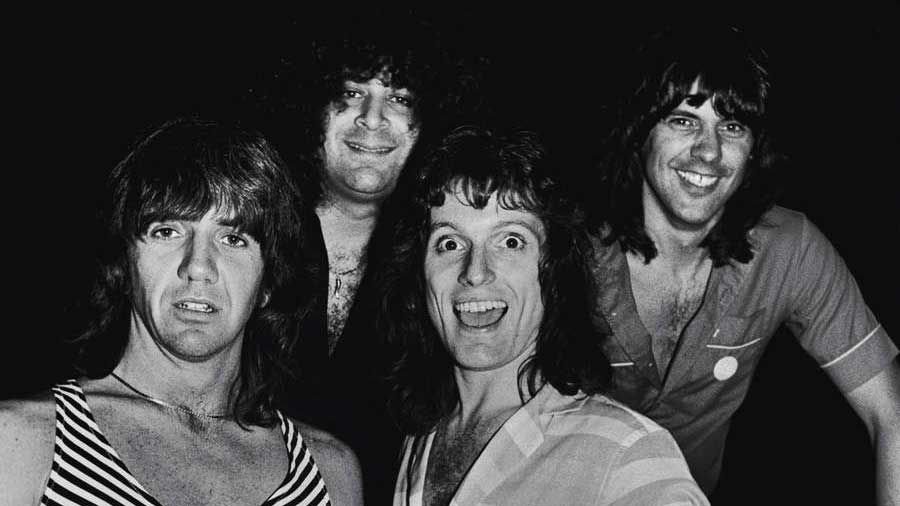
When John Fannon thinks again to the heady days of 1979, when his band New England regarded poised to turn into the following large factor in American rock, he recalls the appropriate second when he believed that the dream would turn into a fact.
It came about because the band had been travelling from their house the town of Boston, Massachusetts to a gig in Denver, Colorado. Their debut unmarried, Don’t Ever Wanna Lose Ya, a melodic rock anthem with a sky-scraping refrain, had simply been launched. It used to be a observe made for radio, and DJs in Boston had been enjoying the shit out of it. However for them to listen to their music ringing out on an FM station close to Denver, up to now from house – that used to be one thing else.
“When the ones chronic chords got here blasting thru, it used to be a unique second,” Fannon remembers. “We knew we had been getting airplay in all places the rustic, however this used to be our first enjoy of listening to it out of doors of Boston. All of us pulled off the street – our caravan, vehicles, excursion bus and truck – and had been dancing and cheering at the aspect of the freeway. I can by no means fail to remember that feeling of pleasure, pleasure, happiness. On most sensible of the arena!”
In that second, New England had such a lot going for them. Fannon, the guitarist and lead singer, used to be an excellent songwriter whose love for The Beatles used to be obtrusive in a legitimate corresponding to a hard-rocking Electrical Mild Orchestra. At the band’s self-titled debut album, Don’t Ever Wanna Lose Ya used to be one of the songs with authentic hit attainable. And on a trade degree, the band had an impressive connection to one in every of The united states’s greatest rock acts – they had been controlled via Invoice Aucoin, the savvy tactician who had guided Kiss to superstardom.
Kiss guitarist and vocalist Paul Stanley co-produced New England’s album along Mike Stone, famed for his paintings with Queen. And for his or her first national US excursion, following that headline display in Denver, the younger band would play to 1000’s each and every evening, opening for Kiss in arenas. As Paul Stanley tells Vintage Rock now, these kinds of years later: “New England used to be a great band, and Don’t Ever Wanna Lose Ya used to be an actual excursion de drive, a super, nice music.”
However for John Fannon and the opposite 3 guys in New England, the enjoyment they skilled as they danced at the aspect of the highway close to Denver can be short-lived. Don’t Ever Wanna Lose Ya would climb to No.40 on the USA Billboard chart, however no upper. The album would top at No.50. And at a essential degree, their occupation can be derailed in essentially the most unfortunate and not going of situations – when their file corporate went bust after playing on an album via, of all other folks, the Pope.
Regardless of how nice New England had been, and the way well-connected, the band didn’t make it large. “The e book on New England is bittersweet,” Fannon says. “‘They will have to had been massive’ is a mantra I’ve heard for 40 years. Nevertheless it’s now not a nasty technique to be remembered.”

It used to be in 1976 that Fannon put the band along with 3 different musicians he’d identified for years at the Boston song scene: keyboard participant Jimmy Waldo, bassist Gary Shea and drummer Hirsh Gardner.
The title of the band used to be now not merely a connection with the area of the USA they had been from. It additionally signified the place they had been coming from – as Anglophiles impressed via The Beatles, Queen, Deep Pink, The Moody Blues and Procol Harum. “For us,” Fannon says, “the title New England used to be now not handiest geographical, like Boston, Chicago, Kansas. It used to be defining us as a brand new breed of English song, and we preferred that!”
In not unusual with such a lot of American musicians of his era, Fannon had “an epiphany” as a youngster when he noticed The Beatles on The Ed Sullivan Display in 1964. Two of The Beatles’ albums had a profound impact on him. “Rubber Soul started my appreciation of songwriting,” he says, “and Magical Thriller Excursion used to be an awakening for me – creativity off the charts! Using orchestral tools and storytelling lyrics had a giant affect on me.”
In 1971, some other key affect for Fannon got here with the self-titled debut album via ELO. “That album used to be the general motivation I had to aspire to be as just right a songwriter as I may well be,” he says. “New England undoubtedly had a heavier aspect, however I at all times beloved what orchestration may do to a music and a melody.”
Fannon honed his craft for some other seven years prior to New England signed with Invoice Aucoin at the advice of his VP Ric Aliberte. “Ric beloved the band,” Fannon says. “He believed in us.” And when Aliberte took Paul Stanley to a band practice session, the Kiss superstar beloved what he heard – an echo of the good British song that had resonated so powerfully in his personal band.
“England used to be the holy land,” Stanley says. “The house of The Beatles, Led Zeppelin, The Who… such a lot of nice bands. And with New England it used to be obviously an Anglophile form of band. John used to be rooted in The Beatles, and being the author and the singer that got here throughout very strongly. That you must additionally pay attention in New England the bands that The Beatles had influenced – it used to be like The Beatles filtered thru ELO.”

Watch On
As co-producer for New England, Stanley’s position style used to be Bob Ezrin, who had labored with Kiss on their 1976 album Destroyer, a big-production blockbuster that raised Kiss’s song to an entire new degree. “Bob used to be an actual manufacturer,” Stanley says, “now not simply the man turning the knobs. He used to be developing the songs.”
“Paul and Mike Stone made a just right crew,” says Fannon, “a just right steadiness of technical and musical enter. Mike used to be an bizarre engineer who captured the power and tool of the band, and Paul introduced famous person power. He gave us numerous self assurance.”
The majority of the New England album used to be recorded in Los Angeles, the place the band won some other well-known admirer. Adventure had been recording in an adjoining room, and their singer Steve Perry would pay attention in to what New England had been growing. “Steve instructed us he beloved our sound,” Fannon says.
The band’s subject material had a wide vary. The album’s opening observe, Hi, Hi, Hi, used to be an excellent power-pop music so with regards to peak-era Jeff Lynne that they might have referred to as it ELO, ELO, ELO. On the heavier finish of the spectrum there used to be the fast moving P.U.N.Okay. (Puny Undernourished Child), of which Fannon says: “I sought after a music that used to be punkish musically, and idea it could be cool to do a lyric that used to be more or less a tongue-in-cheek message with some fact across the edges.”
Crucial music – for the band, and for Fannon in my opinion – used to be Don’t Ever Wanna Lose Ya. As he remembers of the evening it used to be written: “A distinct individual in my existence used to be out in an excessively unhealthy rain typhoon, and the music simply got here to me. The fears one has when you’re frightened a couple of beloved one impressed the lyrics.”
Because of this, Don’t Ever Wanna Lose Ya had an bizarre intensity of emotion, similar to Boston’s international break Extra Than A Feeling. There used to be chronic in its heavy riff, there used to be melodic sophistication with wealthy vocal harmonies and the quivering sound of a Mellotron. However the observe wanted one thing extra to make it best. And it used to be Paul Stanley who referred to as it.
“Initially there used to be no guitar solo,” Fannon says, “as a result of I used to be involved the music used to be too lengthy for radio. However Paul stated: ‘It’s a rock music! You gotta have a guitar solo!’” When Fannon in the end nailed the solo, New England had been within the outdated England – blending the album at Trident Studios in London, on Paul Stanley’s orders. “My handiest prerequisite for doing the album,” Stanley says, “used to be that we jumbled together London – a wholly egocentric resolution as a result of I beloved that town such a lot.” And he laughs when he remembers how he ended up making a song a solidarity section in Don’t Ever Wanna Lose Ya, following a lighthearted spat with drummer Hirsh Gardner.
“Hirsh used to be a humorous man. However this one time, when he used to be making a song backgrounds, I saved announcing: ‘Hirsh, that’s now not moderately proper.’ He used to be doing it over and over again, till he in any case he stated: ‘Neatly why don’t you do it?’ And one take later it used to be performed. In order that close him up within the nicest imaginable manner.”
Traveling with Kiss supplied Fannon with extra superb reminiscences – enjoying to an target market of 60,000 on the Pontiac Silver Dome in Michigan, and 1000’s extra over two nights at Madison Sq. Lawn in New York. “That used to be the brightest spotlight of our appearing occupation,” he says. “The reaction we were given from Kiss lovers used to be fantastic.”

However then got here the autumn, as unexpected because it used to be inexplicable. First there used to be frustration. “We had been confused,” Fannon says, “when our control and file label pulled us off the street to do a brand new album once we had been killing it far and wide and Lose Ya used to be nonetheless going robust.” Then, some months later there used to be outright crisis. “The band’s file label, Infinity, had invested an astronomical sum in an album of speeches and songs in Polish via Pope John Paul II. When that album bombed, with returns approximated at 1,000,000, the label used to be bankrupted.
“We had been in surprise,” Fannon remembers. “The wheels had been starting to come off that categorical we were on.” New England signed to Elektra Data for the discharge of a 2nd album, Explorer Suite, in 1980. However the maintain Elektra temporarily grew to become bitter, and Explorer Suite were given misplaced within the shuffle. As Fannon admits: “Going with Elektra used to be some other massive mistake. There used to be a long lengthen at the album liberate and the band misplaced momentum.”
A 3rd album, Strolling Wild, used to be recorded in simply two weeks in 1981 with the famend studio genius Todd Rundgren (Bat Out Of Hell et al) generating. Rundgren instructed Fannon: “This can be a nice file. Don’t allow them to screw it up!” However as Fannon remembers it: “Elektra had numerous artists already at famous person standing that didn’t require a lot effort. Sadly, bands nonetheless breaking did want some effort! However as soon as once more there used to be little or no promotion for us.”
In 1982, a disappointed Fannon pulled the plug on New England. “I felt the band used to be starting to lose its chemistry. The entire missteps and unhealthy choices had worn us down. It wasn’t amusing any longer.”
Following the cut up, Jimmy Waldo and Gary Shea shaped Alcatrazz with guitar virtuoso Yngwie Malmsteen and ex-Rainbow singer Graham Bonnet. Fannon selected a unique trail, starting as a author of jingles for TV commercials.
In all of the years because the loss of life of New England, he has persevered to paintings in more than a few capacities. “Composer, sound fashion designer and manufacturer.” He now considers himself “semi-retired”. However lately the 4 authentic individuals of New England have reunited to accomplish reside once more, in Japan in 2016 and in the USA in 2019. Fannon believes there’s extra to return.
“To nowadays we’re nonetheless the most efficient of buddies,” he says. “So there’s a great opportunity we can do extra presentations. And I’ve been announcing for years we would possibly perform a little new song. This is nonetheless a chance.”
The summer season of 2023 introduced an surprising twist, when the intro of the identify observe from Explorer Suite used to be sampled in famous person rapper Travis Scott’s hit unmarried Sirens. “It will be superior if this gave New England publicity to a brand new era,” Fannon says.
And regardless of the long run holds, he can also be happy with what his band created up to now. That first New England file is a masterpiece, one of the vital biggest AOR albums of all time.
“If it wasn’t for a great typhoon of hindrances and misfortunes, we will have were given to the highest,” Fannon says. “We devoted a lot of our formative years to looking to make some nice, undying song… and we accomplished that.”
New England’s reissued self-titled debut album is out now by means of Rock Sweet.